


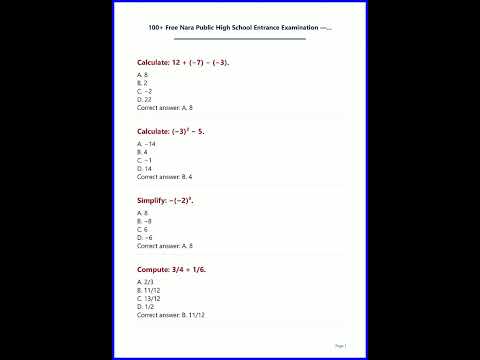
Choosing an accelerated algebra elective in middle school can help a mathematically ready student move beyond grade-level coursework and prepare for advanced high school classes. The right option is not simply the course with the fastest pace or the word “honors” in its name. Families should compare prerequisites, curriculum, workload, available support, and the student’s interest in taking on a deeper challenge. This guide to an accelerated algebra middle school electives list explains common course options, how they differ, and how to decide which path makes sense.
What “Accelerated Algebra” Means in Middle School
Accelerated algebra is a course sequence that introduces algebraic concepts earlier or covers them at a faster pace than a standard middle school math pathway. Depending on the school, students may encounter pre-algebra in sixth grade, Algebra 1 in seventh or eighth grade, or a combined course that compresses material normally taught across multiple years.

There is no single nationwide middle school algebra sequence. Course names, placement rules, and high school credit policies vary by district and state. An elective labeled “accelerated math” may include Algebra 1, while another school may reserve that name for a compacted course covering advanced arithmetic, geometry, and introductory algebra. Always request the syllabus or course description rather than relying on the title alone.
Acceleration should mean appropriate readiness and a coherent learning path—not skipping essential foundations. Students still need fluency with fractions, ratios, signed numbers, and proportional reasoning to succeed with equations, functions, and more advanced mathematics.
Accelerated Algebra Middle School Electives List
The following list covers common elective and advanced-course options. Not every school offers every course, and some may count as a core math class rather than an elective.
- Pre-Algebra or Accelerated Pre-Algebra: Strengthens rational-number operations, ratios, percentages, expressions, equations, and coordinate-plane skills. It is a common bridge for students preparing to take Algebra 1 before high school.
- Compacted Math 7/8: Combines selected seventh- and eighth-grade standards into a faster sequence. It often includes proportional relationships, linear equations, functions, geometry, statistics, and probability.
- Algebra 1: Develops skills with variables, equations, inequalities, systems, exponents, polynomials, and linear or introductory nonlinear functions. Some districts award high school credit; others treat middle school Algebra 1 as preparation without transcript credit.
- Honors Algebra 1: Typically covers Algebra 1 with greater depth, more complex applications, or a quicker pace. “Honors” is not a standardized curriculum, so compare learning objectives and assessments.
- Geometry or Honors Geometry: Often follows Algebra 1 for students on an accelerated sequence. Topics can include proofs, transformations, similarity, congruence, coordinate geometry, and measurement.
- Algebra Enrichment or Problem-Solving Elective: Extends classroom learning through mathematical investigations, puzzles, modeling, coding, or competition-style problems. It may supplement—not replace—a formal Algebra 1 course.
- STEM, Coding, or Data Science Elective: Applies algebraic reasoning to programming, robotics, spreadsheets, statistics, and real-world data. These courses can build useful mathematical thinking even when they do not award algebra credit.
How the Main Course Options Compare
| Course option | Typical focus | Best fit | What to confirm |
| Accelerated pre-algebra | Foundations and early algebra | Students ready for a faster transition into abstract reasoning | Whether the course prepares students for Algebra 1 the following year |
| Compacted math | Multiple grade-level standards in one sequence | Students with strong prior achievement and consistent work habits | Which standards are included and how gaps are addressed |
| Algebra 1 | Equations, functions, expressions, and modeling | Students who demonstrate readiness on prerequisite skills | Credit status, placement rules, and the next course in the sequence |
| Honors Algebra 1 | Algebra 1 at greater depth or pace | Students who enjoy challenge and can manage independent practice | How the honors course differs from standard Algebra 1 |
| Enrichment or STEM elective | Applications, investigations, or mathematical creativity | Students seeking a broader experience alongside core math | Whether it is supplemental or fulfills a required math placement |

Beginner, Intermediate, and Advanced Readiness
Beginner: Build the bridge to algebra
A student does not need to be a math competition winner to begin an accelerated pathway. However, reliable foundational skills matter. Before moving into a faster algebra course, students should be comfortable with multi-step arithmetic, fractions and decimals, negative numbers, ratios, percentages, and interpreting simple graphs. They should also be willing to explain how they reached an answer, not just produce one.
If these skills are uneven, a strong pre-algebra course or targeted summer review may be more effective than skipping ahead. A short skills check with the school’s math department can identify specific gaps without treating one test score as the whole picture.
Intermediate: Take Algebra 1 with support
Students ready for Algebra 1 can work with variables, translate word problems into equations, recognize patterns, and persist when a solution takes several steps. Prior grades are useful evidence, but teachers can also speak to class participation, accuracy, and how independently a student completes practice.
Ask what support is available if the pace becomes difficult. Useful supports include teacher help sessions, tutoring, reassessment opportunities, guided notes, and access to practice problems with worked examples. An accelerated course should be challenging without making help-seeking feel like failure.
Advanced: Plan the full sequence, not just the next class
Students who complete Algebra 1 in middle school may be eligible for geometry, Algebra 2, or another advanced high school course. The next placement depends on district policy, demonstrated mastery, and whether the middle school course counts for credit. Plan with a counselor or math department so that acceleration does not create an awkward gap later.
Consider the student’s broader schedule, too. A demanding math class can be rewarding, but it should fit alongside language arts, science, activities, sleep, and family commitments. The strongest pathway is one the student can sustain while continuing to learn deeply.
How to Choose the Right Elective
Use these questions when comparing an accelerated algebra elective or course sequence:
- What is actually taught? Request the course outline, textbook or materials, major units, and expected entry skills.
- How is placement determined? Ask whether the school considers grades, teacher recommendations, diagnostic assessments, or multiple measures.
- Is high school credit awarded? Confirm how the course appears on the transcript, whether a final exam is required, and how the grade is calculated.
- What happens after the course? Identify the next available class and its prerequisites before committing to acceleration.
- How much independent work is expected? Find out about homework frequency, project deadlines, and the typical pace of new material.
- Can students move between pathways? Ask whether placement can be adjusted if the student needs more time or demonstrates readiness for a faster track.
It is also worth asking how the course teaches mathematical reasoning. Strong algebra instruction includes explanations, multiple solution methods, error analysis, and applications—not only repetitive worksheets. Students should have opportunities to connect symbolic work to graphs, tables, diagrams, and real situations.
Practical Ways to Prepare for Accelerated Algebra
Preparation is most useful when it reinforces concepts rather than racing through a textbook. A manageable routine can build confidence and reveal topics that need review.
- Review fraction operations, decimals, percentages, ratios, and negative numbers.
- Practice simplifying expressions and substituting values for variables.
- Translate short word problems into equations, then explain what each part represents.
- Read graphs and tables, looking for patterns and relationships between quantities.
- Check answers by estimating, substituting a result back into an equation, or using another method.
For families, the most helpful message is that confusion is part of learning difficult mathematics. Encourage students to show their work, identify the exact step where they got stuck, and ask a focused question. These habits are more valuable than finishing every assignment quickly.
Common Mistakes to Avoid
- Choosing by course title alone: “Advanced,” “honors,” and “accelerated” can mean different things from one school to another.
- Assuming acceleration guarantees a particular career advantage: Early Algebra 1 can open scheduling options, but student learning and well-being matter more than moving ahead for its own sake.
- Overlooking prerequisite gaps: Weak fraction or proportional-reasoning skills can make later algebra unnecessarily frustrating.
- Ignoring the next course: Confirm the sequence through high school, including placement requirements and credit policies.
- Treating speed as mastery: A student who finishes quickly may still benefit from deeper problems, clear explanations, and review.
Frequently Asked Questions
What is the best accelerated algebra elective for middle school students?
The best option depends on readiness and the school’s course sequence. Accelerated pre-algebra is a useful bridge for students strengthening foundational skills; Algebra 1 is appropriate when the student meets prerequisites and can manage the pace. Compare curriculum and placement guidance rather than selecting by label alone.
Can a middle school student take Algebra 1 in seventh grade?
Some districts allow seventh graders to take Algebra 1, but policies vary. Placement may depend on prior coursework, assessment results, teacher recommendations, and demonstrated mastery. Contact the school’s math department to learn its criteria and understand what course follows.
Does middle school Algebra 1 count for high school credit?
Sometimes. Credit rules differ by district and state, and some schools require a specific course, exam, or minimum grade. Ask the counselor whether the class appears on the high school transcript and whether it affects graduation requirements or later placement.
What should students know before accelerated Algebra 1?
Students generally benefit from fluency with fractions, decimals, percentages, ratios, negative numbers, expressions, and basic equations. They should also be ready to interpret graphs, explain their reasoning, and work through multi-step problems.
Is honors Algebra 1 much harder than regular Algebra 1?
It may move faster, explore topics in greater depth, or assign more complex applications, but there is no universal honors standard. Ask the school how pacing, assessments, homework, and course content differ from its standard Algebra 1 class.
Should a student take summer algebra before middle school?
Summer study can help when it reviews prerequisite skills or follows a school-approved course plan. Before enrolling in a fast-paced online or outside program, confirm that the school accepts the coursework for placement or credit. A short, focused review is often more useful than an unapproved course that cannot be applied to the student’s sequence.
Conclusion
An accelerated algebra middle school electives list can include pre-algebra, compacted math, Algebra 1, honors Algebra 1, geometry, enrichment, and STEM electives. The right choice balances mathematical readiness, teaching quality, course workload, student interest, and the high school sequence ahead. Verify prerequisites and credit policies with the school, then choose a path that offers challenge alongside support. When students build strong foundations and understand why algebra works, acceleration becomes a meaningful opportunity rather than simply a race to the next course.
