


Choosing between an AMS Montessori school and a traditional public school is not simply a choice between “independent learning” and “regular classes.” It is a decision about how your child will spend the school day, how teachers guide learning, what resources are available, and which environment best fits your family. AMS stands for the American Montessori Society, an organization that sets standards and accredits Montessori programs. Traditional public schools, meanwhile, vary widely by district, state, and individual school. Understanding those distinctions can help you compare real options—not idealized versions—and ask better questions on a school tour.
What Does AMS Montessori Mean?
An AMS Montessori school follows an educational approach based on the work of Maria Montessori, with program standards and professional guidance associated with the American Montessori Society. AMS membership or accreditation can offer useful evidence of a school’s commitment, but families should check the school’s specific status and never assume that every program using the word “Montessori” has the same training, materials, or classroom practices.
In a Montessori classroom, children generally work with carefully designed learning materials, choose from appropriate activities, and progress through concepts at a pace suited to their readiness. Teachers—often called guides—observe, present lessons, and help students select productive next steps. This is structured independence, not a classroom without rules or instruction.
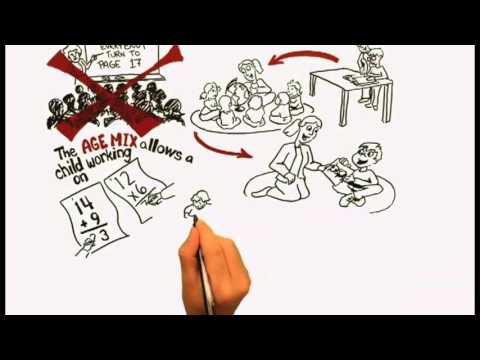
Many Montessori programs use mixed-age classrooms, commonly spanning a three-year age range. A child may learn alongside younger classmates while practicing a skill and later model that skill for a new group of students. The exact age groupings, schedule, and curriculum depend on the school and program level.
How Traditional Public Schools Usually Work

Traditional public schools are publicly funded and generally serve students according to district boundaries and enrollment rules. Most organize students by grade and use a planned curriculum aligned with state standards. Teachers deliver lessons to a class, check understanding, and adapt instruction through small groups, assignments, assessments, and other supports.
“Traditional public school” is not one uniform model. A neighborhood school may offer project-based learning, dual-language instruction, gifted services, special education, or a strong arts program. Class sizes, staffing, technology, extracurricular activities, and family engagement also differ. For a meaningful comparison, evaluate the actual AMS Montessori program and public school available to your child—not assumptions about either category.
AMS Montessori vs. Traditional Public School: Key Differences
| Area | AMS Montessori | Traditional public school |
| Classroom organization | Often mixed-age groups and activity areas | Usually students grouped by grade |
| Learning sequence | Individualized pacing within a prepared curriculum | Grade-level scope and sequence, with differentiated support |
| Teacher’s role | Observes, gives individual or small-group lessons, and guides work | Teaches whole-class lessons and supports individuals and groups |
| Student choice | Children often choose among appropriate work activities | Choices may be offered within teacher-planned lessons and schedules |
| Learning materials | Hands-on Montessori materials are central in many programs | Textbooks, digital tools, manipulatives, and other resources vary |
| Assessment | May emphasize observation, portfolios, and demonstrations alongside other measures | Often includes classroom assessments and district or state testing |
| Cost and access | Private tuition may apply; public Montessori programs also exist | Publicly funded for eligible students, subject to district policies |
The table describes common patterns, not guarantees. A Montessori school may use tests, and a public school may provide hands-on, student-led projects. Ask each school how its daily practice compares with its stated philosophy.
Curriculum, Academics, and Learning Pace
Montessori learning and academic progression
Montessori lessons often move from concrete experiences toward abstract understanding. A child might handle quantity materials before working with written number symbols, or explore grammar through physical materials before analyzing sentences on a page. The aim is to build understanding through purposeful practice, not simply to cover a topic once in a whole-class lesson.
Because students may work at different levels, the teacher’s observation and lesson planning matter. Ask how the school tracks reading, writing, mathematics, and other academic progress, and how it responds if a student is advancing quickly or needs additional support. A strong program can explain how individual work connects to curriculum expectations and how families receive clear progress updates.
Public school standards and classroom instruction
Traditional public schools generally plan instruction around state learning standards and grade-level expectations. This can give families a clear framework for what students are expected to know each year. Teachers may use whole-class instruction, guided practice, independent work, and small-group reteaching to address different needs.
In some districts, common assessments and report cards make it easier to compare progress against grade-level goals. However, those measures do not capture every aspect of learning. Ask how teachers use assessment results, what intervention is available, and whether students can receive enrichment when they have already mastered material.
Classroom Culture, Independence, and Social Development
Montessori education often emphasizes concentration, orderly use of materials, practical life skills, and responsibility for one’s work. Students may learn to choose an activity, complete it, restore materials, and move to another task. This can suit children who enjoy sustained focus and benefit from opportunities to manage parts of their day.
Traditional public classrooms often provide a more shared schedule, with lessons and activities coordinated for the group. This structure can help children who thrive on predictable transitions, frequent teacher direction, or a common rhythm. It also offers regular practice in working as part of a same-age class, following whole-group instructions, and contributing to collaborative activities.
Neither approach automatically produces stronger social skills. The quality of teacher-student relationships, peer culture, classroom management, and support for conflict resolution matters more than the label alone. During a visit, look for how adults respond when children disagree, make mistakes, or need help rejoining an activity.
Cost, Enrollment, and Access
Many AMS Montessori schools are private and charge tuition, although tuition assistance may be available. There are also public Montessori schools and Montessori programs within public districts. Their eligibility rules, transportation options, attendance boundaries, and availability vary, so confirm details directly with the school or district.
A traditional neighborhood public school generally does not charge tuition to students eligible to attend, but families should still consider practical costs such as transportation, meals, supplies, childcare, and after-school activities. Compare the complete family cost and daily logistics—not tuition alone.
Also ask about services that matter to your child: special education, speech or occupational therapy, English language development, counseling, advanced coursework, and learning accommodations. A school’s ability to provide appropriate support is a central part of fit.
Which School Is a Better Fit for Your Child?
Start with your child’s needs rather than with claims that one model is universally superior. Consider how your child responds to choice, transitions, independent tasks, group lessons, and extended periods of concentration. These tendencies can inform your questions, but they do not predict success by themselves; children adapt, and good teaching can support different learning styles.
- Define your priorities. List the academic, social, cultural, accessibility, and logistical factors that matter most to your family.
- Visit both settings. Observe a normal school day if possible, rather than relying only on a presentation or brochure.
- Ask about evidence of progress. Find out how teachers identify strengths, communicate concerns, and support students who need more challenge or extra instruction.
- Review practical details. Confirm schedule, transportation, meals, enrollment deadlines, tuition or fees, and continuity into later grades.
- Talk with families. Ask current parents what surprised them, what they value, and what they wish they had known before enrolling.
Questions to Ask on a School Tour
- What does a typical day look like, including transitions, recess, and specialist classes?
- What Montessori teacher training do lead teachers have, and what is the school’s current AMS status?
- How do you monitor reading and math progress, and how often do families receive updates?
- How do you support children who are struggling, need accommodations, or are ready for advanced work?
- What is the classroom age range, and how are students grouped for lessons?
- How do you handle discipline, peer conflict, and emotional or behavioral needs?
- What happens when a student transfers into or out of the program?
Listen for concrete examples rather than broad promises. A school should be able to explain how its approach works in practice, who is responsible for student support, and how families can raise concerns.
Common Misconceptions About Montessori and Public School
“Montessori means children do whatever they want.”
Not in a well-run program. Children usually have choices within established expectations, a prepared environment, and teacher guidance. Independence is taught and practiced; it is not the absence of boundaries.

“Public school is always the same from one school to another.”
Public schools differ substantially in teaching practices, resources, class composition, enrichment, and student services. A district’s programs and the individual school community can shape a child’s experience as much as the broad instructional model.
“One approach guarantees better academic results.”
No school model guarantees an outcome for every child. Student progress depends on many factors, including instruction quality, access to support, attendance, family circumstances, and how well the learning environment meets the child’s needs. Compare the specific school’s practices and available evidence rather than relying on sweeping claims.
Frequently Asked Questions
Is an AMS Montessori school better than a traditional public school?
Not for every child or family. AMS Montessori may be a strong fit for families seeking guided choice, hands-on materials, and mixed-age learning. A traditional public school may be a better fit when its grade-level structure, services, location, or programs meet the child’s needs. Visit and compare actual schools.
What is the difference between AMS accreditation and a school calling itself Montessori?
AMS accreditation indicates that a program has undergone a review against the organization’s standards. Schools may use the Montessori name without holding AMS accreditation, so ask about current status, teacher preparation, classroom practices, and how the program delivers Montessori education.
Can my child attend a public Montessori school?
Possibly. Some public districts operate Montessori schools or programs, but availability and enrollment processes differ. Contact your district to ask about attendance boundaries, applications, lotteries, transportation, and required deadlines.
Will a child from Montessori be prepared to transfer to traditional public school?
Many children transition successfully, but the experience depends on the student and the schools involved. Ask how the Montessori program documents academic progress, teaches routines used in the receiving school, and supports students during transitions. Share records and discuss placement with the new school early.
How should parents compare Montessori and public school academics?
Ask both schools how they teach core subjects, measure progress, address learning gaps, and provide enrichment. Review examples of student work and reporting. Compare the school’s real curriculum and support practices, not just its teaching label or test scores.
Is Montessori more expensive than traditional public school?
Private Montessori programs commonly charge tuition, while public schools generally do not charge tuition to eligible students. Public Montessori programs may also be available. Compare tuition assistance, fees, transportation, childcare, and other costs to understand the full financial picture.
Conclusion
The AMS Montessori vs. traditional public school decision comes down to the child, the specific school, and the family’s priorities. Montessori programs often organize learning around guided independence, hands-on materials, and mixed-age communities. Traditional public schools commonly use grade-level groupings, shared instruction, and district curriculum standards, while offering a wide range of local programs and supports. Neither model is inherently right for every student. Visit, ask direct questions, examine how progress and support are handled, and choose the setting where your child is most likely to feel safe, engaged, and appropriately challenged.
